
How to start a clothing brand (without a warehouse)
The seven-step playbook we've watched work, from the shop that prints first drops every month. One great drop beats a garage full of inventory — here's how to run yours.
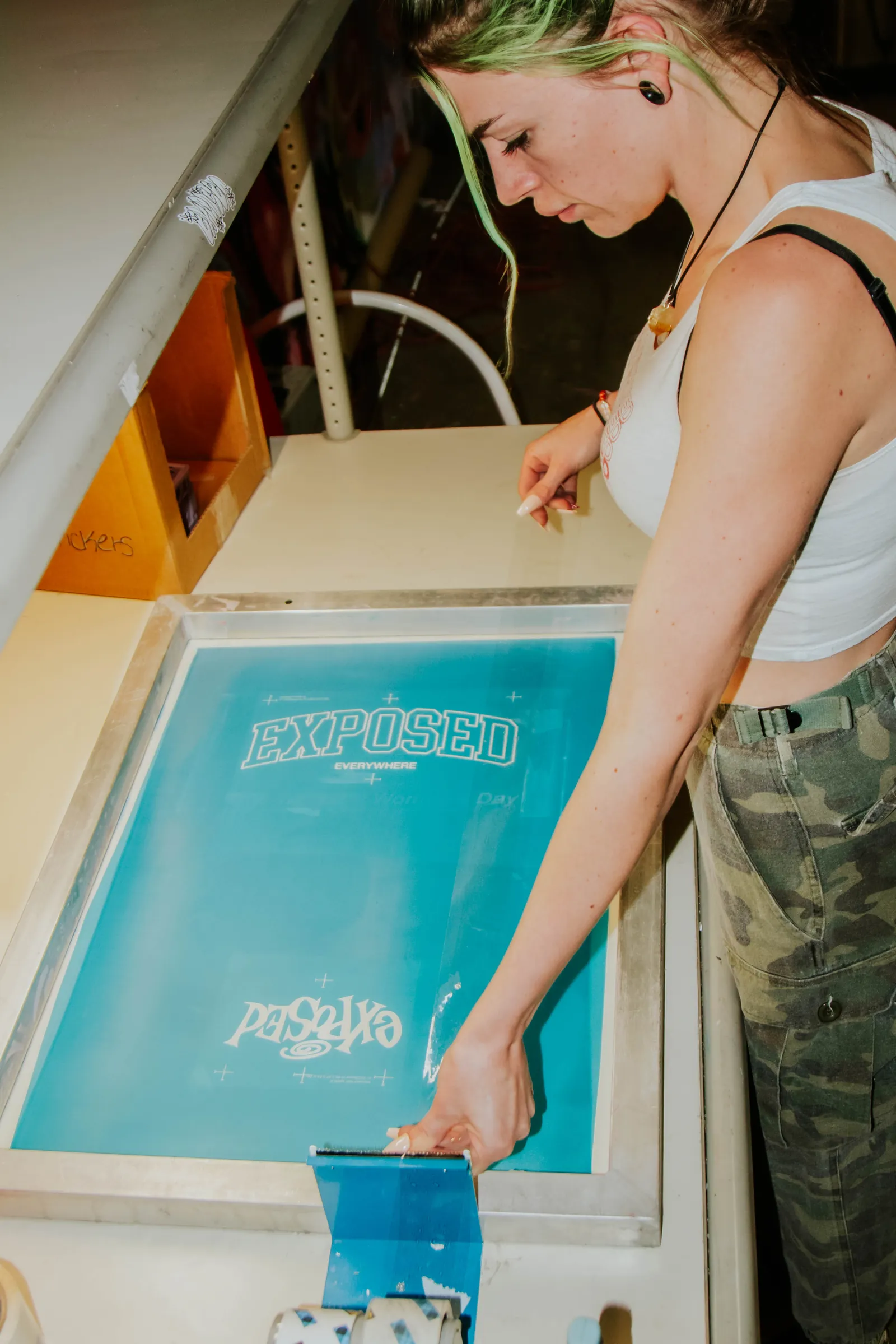
Here's what nobody selling a course will tell you: you don't need a warehouse, a fulfillment contract, or a 5,000-piece overseas order to start a clothing brand. You need one great drop — a design people want, on a shirt they'd wear blank, in a quantity you can actually sell out. Everything past that is spreadsheet work.
We're Fully Exposed Graphics, a print and embroidery shop in Albuquerque. Brands launch out of this building every month, and the ones that survive all do roughly the same seven things. None of those things require a big budget. All of them require discipline. Here's the playbook.
Step 1: Nail one idea, not ten
The brands that pop have a point of view. One. Scroll any feed and the labels you remember aren't the ones with fifty designs — they're the ones where you could describe the whole brand in a sentence. Desert-goth workwear. Loud Chicano lowrider graphics. Minimal skate typography. Pick your lane and drive in it.
Practically, that means your first drop is one or two designs, not eight. Eight designs splits your budget eight ways, muddies your story, and leaves you with seven boxes of shirts nobody asked for. One design executed hard — right blank, right print, right photos — tells people exactly who you are. Positioning isn't a marketing-class abstraction; it's the filter that makes every later decision (blank, fit, price, drop date) easy.
If the idea can't survive being the only shirt you sell for three months, it's not the idea. Keep sketching. And if the art in your head isn't the art in your files yet, that's fixable — we design in-house and rebuild rough concepts into print-ready separations every week.
Step 2: Pick blanks like they're the product — because they are
Your customer never sees your emulsion technique. They feel the shirt. The blank is the product, and the graphic is the reason they picked it up.
The fault line in 2026 is heavyweight versus standard. Heavyweight blanks — Comfort Colors, AS Colour, Shaka — run thicker fabric with a boxier cut, and they're what streetwear customers expect a shirt at retail prices to feel like. Standard blanks like Gildan and Bella+Canvas are lighter, cheaper, and right for some brands — but if your customer touches the shirt and it feels like a 5K-race giveaway, the graphic can't save you.
We stock and print all of the above, and we'll hand you the actual blanks to feel before you commit. For the full breakdown by brand, weight and print surface, read our ranking of the best blank t-shirts for screen printing. Then choose the blank your customer would buy empty. That's the test.
Step 3: Choose your print method by run size
New founders agonize over print method like it's a religion. It's arithmetic. The question isn't "which method is best" — it's "how many pieces of this design am I printing right now."
Screen printing is for the drop. Once you're printing 12+ of one design, screen printing gives you the most durable print and the best per-shirt cost. Two things drive that cost: quantity and ink colors. Each color needs its own screen, each screen carries a one-time setup cost, and that setup spreads thinner across every shirt you add — which is why price breaks reward committing to a real run instead of dribbling out six at a time. Water-based inks get you that soft, no-feel print premium brands are known for.
DTF is for testing. Not sure a design will sell? DTF transfers have no minimum and no setup — print five shirts, post them, and let your audience vote with their wallets before you burn screens on 48. Unlimited colors for one price, too, so a full-color concept costs no more to test than a one-color one. It's the cheapest market research in apparel. Full comparison in DTF vs screen printing.
The sequence that works: test small with DTF, then screen print the winner at quantity. Final pricing always depends on your art, blank and locations — that's what an itemized quote is for.
Step 4: Make it retail-real
Flip over a shirt from any brand you respect. No scratchy manufacturer tag — a printed neck label with the brand's mark and sizing. Maybe a woven hem tag. It arrived folded in a polybag, not stuffed in a grocery sack.
These details barely move your per-shirt cost, and they're the difference between "my buddy prints shirts" and a label someone screenshots and sends to a friend. Neck label printing, hem tags, folding and polybagging are exactly what our brand merch service exists for — you send art, you get back product that looks like it shipped from a store, because it should.
One founder rule: if you wouldn't pay retail for the package that shows up at your own door, don't ask a stranger to.
Step 5: The margin math that keeps you alive
Most first brands die of arithmetic, not bad design. And the arithmetic starts with one number: your landed cost per shirt — everything you spend to get one finished, packed shirt into your hands. Here's every line that goes into it on a typical 48-piece drop with a 1–2 color print and retail finishing:
| Line item (48-piece drop) | What it does to your landed cost |
|---|---|
| Premium heavyweight blank | The biggest single line — your largest lever, up or down |
| 1–2 color screen print | A one-time setup per screen, spread across the run, plus a per-piece print cost |
| Printed neck label | A small per-shirt add — the detail that makes a shirt read retail |
| Hem tag + fold & polybag | A small per-shirt add for finishing and packaging |
| Landed cost per shirt | All four lines added together — the only number your retail price should be built on |
The rule that keeps brands breathing: price at three to four times your landed cost. Multiply, don't add. At 3–4x, one sale, one giveaway, a platform fee and a shipping label still leave you with enough to print the next drop. At 2x, those same four things put you at zero, and you find out in month three. Run the multiplier on your own landed cost and check where it lands against what heavyweight streetwear already sells for — if your number is far above the market, the blank or the finishing is where to look first.
That's the whole engine. Sell out a drop priced at a real multiple, and the margin covers your product cost several times over, which funds a bigger drop, which earns a better price break. Each run pays for the one after it — but only if you knew your landed cost before you set your price.
Do this math with your numbers, not estimates: your landed cost is the blank plus the print plus any finishing. We itemize every one of those lines on your quote, so you can multiply against a figure that's actually yours instead of a range from a blog post — get yours here, free.
Step 6: Start with 24–48 pieces, sell out, reorder
Scarcity beats stockpiles. A 48-piece drop that sells out in a week does more for your brand than 500 shirts aging in your closet ever will. "Sold out" is marketing. Dead stock is a tombstone.
30–48 pieces is the sweet spot for a first drop: big enough to hit screen printing price breaks, small enough that selling out is achievable, cheap enough that a miss is a lesson instead of a disaster.
And here's the part founders miss — the reorder is where the economics get good. At shops that archive your art (we do), reprinting an existing design typically skips setup entirely: your separations and specs are on file, so round two is faster and cheaper per shirt. Sell out, restock, repeat. That loop is the business.
Step 7: Build a launch rhythm, not a launch day
Brands that last don't "launch" once — they drop on a rhythm. Pick a cadence you can sustain (every six to eight weeks is plenty), announce the date, and let anticipation do work that ad spend can't. A drop date also forces the deadline discipline that gets art finished and proofs approved on time — build in production lead: a typical run takes 7–10 business days once the proof is signed off, with rush available when it isn't.
Preorders de-risk everything. Take orders for a window, then print to that number plus a small buffer. You're never guessing sizes, never fronting cash for inventory nobody claimed.
The process is the content. Screens burning under UV, ink flooding across mesh, your shirts coming off the dryer — that's the content people actually watch, and you can't fake it with mockups. Shops like ours will shoot your run on press if you ask; we're on Instagram at @fully_xposed doing exactly that with our own work. Ask your printer before the run, not after.
The honest close: your printer is a supply-chain decision
Strip the romance off and a clothing brand is design plus supply chain, and your print shop is most of the supply chain. Pick one the way you'd pick a business partner: do they answer the phone, send a real digital proof before printing, hand you an itemized quote, and inspect what goes in the box? That's the whole checklist. (Ours, for the record: 5.0 stars on Google, BBB A+, and every order proofed and hand-inspected — see the work in the gallery.)
You don't need permission, a warehouse, or a course. You need one great drop and a shop that treats it like their own. Send us the idea — we'll send back real numbers and a proof.
Quick answers before you go
How much does it cost to start a clothing brand?
Less than the courses imply. A realistic first drop is 24–48 shirts on premium blanks, and four things set your product cost: the blank you choose, how many ink colors your design uses, your quantity, and retail finishing like printed neck labels. Those are the levers you control. The actual number comes from an itemized quote on your specific design — not from a blog post, ours included.
How many shirts should my first drop be?
24–48. You hit real price breaks, selling out is achievable, and a sell-out sets up a reorder — which typically skips setup at shops that archive your art.
Do I need an LLC to start a clothing brand?
Not to print shirts — plenty of brands start as sole proprietors and formalize once revenue shows up. We're printers, not lawyers: take structure and tax questions to an accountant or attorney.
Quick answers
How much does it cost to start a clothing brand?
Less than the courses imply. A realistic first drop is 24–48 shirts on premium blanks, and four things set your product cost: the blank you choose, how many ink colors your design uses, your quantity, and retail finishing like printed neck labels. Those are the levers you control. The actual number comes from an itemized quote on your specific design — not from a blog post, ours included.
How many shirts should my first drop be?
24–48 pieces. That quantity hits screen printing price breaks, is small enough to sell out, and selling out is better marketing than a closet of dead stock. Reorders at shops that archive your art typically skip setup.
Do I need an LLC to start a clothing brand?
Print shops don't require one — plenty of brands start as sole proprietors and formalize once sales pick up. Business structure and tax questions belong with an accountant or attorney, not your printer.